


Q&A with Phillip Bradley author of Inferno
- Allen & Unwin

- Nov 4, 2025
- 4 min read
We talk with Inferno author Phillip Bradley.

In Inferno, acclaimed military historian Phillip Bradley brings to life the experiences of Australians on the Western Front through hundreds of firsthand accounts — many never before published. Drawing on decades of research and visits to the battlefields, Bradley reveals the courage, loss, and endurance that defined a generation.
A&U: You first visited the Western Front in 1981 and have been returning for decades. What first drew you there, and how have those battlefields changed the way you understand Australia’s wartime story?
PB: I have always been interested in Australian Military History so when I first visited Europe in 1981, I was keen to see the Australian WW1 battlefields. In my opinion you can’t understand any battle until you have walked the ground.
A&U: Inferno began as a book about one battle — Bullecourt — before expanding to the entire Western Front. How did that shift open up new ways to tell the story of the Diggers?
PB: Expanding the scope of the book led to me focusing on the experiences of the participants in the various battles rather than trying to cover every detail of those battles. I had used a similar process when I wrote my Australian Light Horse book and knew it would also work here despite the increased scale of the project.
A&U: You drew on over 500 diaries, letters, and interviews — many never published before. What challenges did you face in piecing together such detailed first-hand accounts more than a century after the events?
PB: This was very challenging and took a great deal of time and research. Having dated diary entries helped as did the availability of unit war diaries online which I could cross reference. Cross referencing service records which are also available online was also useful. For example, a letter home from hospital may describe in detail how a soldier was wounded but provide no date. Using that soldier’s service record, one could confirm the date of the incident and therefore put it into the correct place in the narrative.
A&U: Were there any individual soldiers’ stories that stayed with you long after you finished writing?
PB: One stands out. It is a story from the memoir of Ray Bishop whose brother Gordon served in a separate unit. When Ray hadn’t heard from his brother for four weeks, he visited Gordon’s battalion which was resting behind the lines. Here he was told Gordon had been killed during the fighting near Polygon Wood in Belgium. ‘The reply brief, vivid, final’ as Ray wrote. Post war, Ray’s sister told him that her and Ray’s young brother Eric had seen the clergyman visit the family home at the time and had to wait in another room before finding out which brother they would never see again.
A&U: The book also features German perspectives. How did including the German side change or deepen your understanding of these battles?
PB: There are two sides to every story and it was important to me to show that the experience on the German side mirrored what was happening on the Allied side. This certainly deepened my understanding of the battles and should do the same for the reader.
A&U: The Western Front is often overshadowed by Gallipoli in Australian memory. Why do you think this campaign deserves equal, if not greater, attention?
PB: Gallipoli will always be prominent in Australian memory due to Anzac Day but more Australians served and died on the Western Front than at Gallipoli. The actions of the Australian divisions on the Western Front also made a significant contribution to the defeat of Germany in the First World War.
A&U: After decades of studying this period, what do you think Inferno reveals about who we were as a nation — and who we still are today?
PB: In the First World War Australia was strongly aligned with Britain and the name of our force, the Australian Imperial Force reflected that. Today Australian has changed in make-up but still has a close affinity with Britain. In my opinion we should maintain that affinity which has given us so many of our values- our government and legal systems in particular.
A&U: What do you hope modern readers — especially younger Australians — will take away from Inferno?
PB: I hope that all readers will understand the sacrifices Australians made in the name of stopping an aggressor. With our WW1 and most of our WW2 veterans now gone, younger Australians will need to read such books to ensure they understand an important part of our history.
A&U: Did writing Inferno change how you personally view the ANZAC legacy?
PB: I have always had great respect for all Australians who have served their country. Having gained a wider understanding of just what those Australians who served in World War One went through, my admiration for their service and sacrifice has only grown.
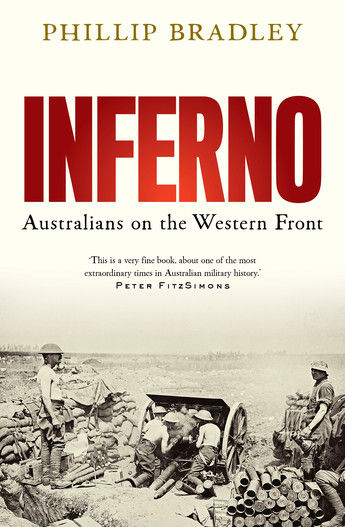
Inferno
by Phillip Bradley
The epic story of the Australians on history's greatest battlefront, 1916–1918.
Comments