


How Anzac POWs survived behind enemy lines

Katrina Kittel on the extraordinary escapes of Anzac POWs in wartime Italy.
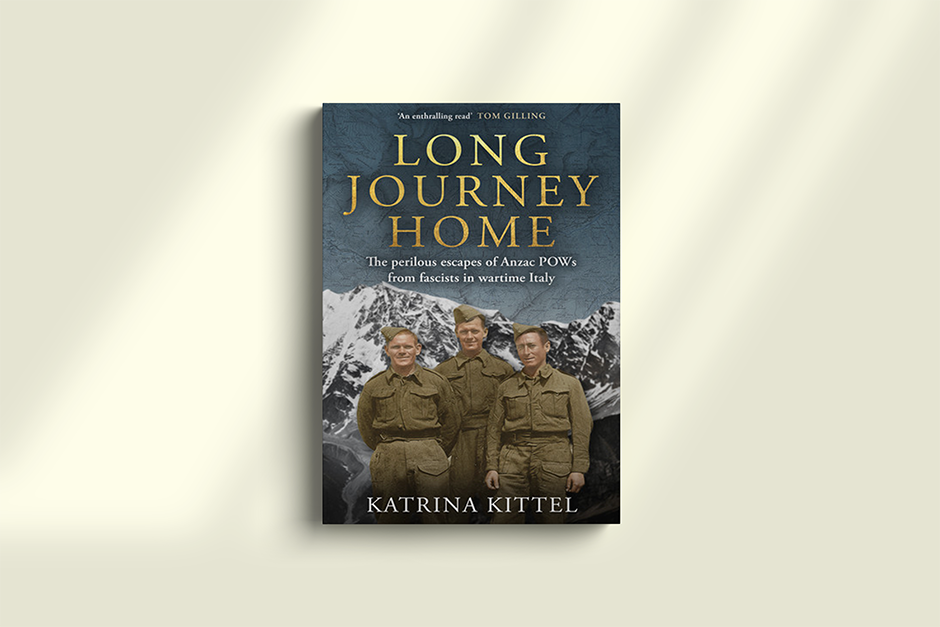
A&U Can you tell us a little about your book Long Journey Home?
KK: My book follows Anzac soldiers from POWs from battle in north Africa, to their dangerous travel by ship to Italy, and to a string of prison camps. For one thousand Anzac POWS, their war would change gears once they were sent in April 1943 to work on the rice-growing plain between Turin and Milan. To their surprise, they worked alongside itinerant workers, including women. POWs sabotaged rice plants and equipment, enacting strikes to subvert authority. A watershed moment came when Italy signed an armistice with the Allies. The Anzacs’ escapes from the farms were mostly easy, and they set out, with or without a map or a mate, into Italy. Was it the best strategy to head south towards Allied Lines, or north to the soaring alps to the north, and to fall into precarious shelter offered at great risk to local people?
By choice or by circumstance, not all of the Anzac POWs would make it into neutral Switzerland before winter set in. Those POWs who remained in Italy into 1944 and 1945 faced the wrath of fascist violence to themselves, and their Italian helpers: a theme of trying to survive the war, for civilians and the POWs with bounties on their head.
I would discover why, and where, my father decided to name his firstborn son after his escaper mate Peter.
I recalled incidents which involved me and my father, and which should have nudged me to ask him more.
A&U: What inspired you to write Long Journey Home?
KK: In 2011, my teenage son wore my father's war medals to march with his school on ANZAC Day, but I knew very little to tell him about his grandfather's war, despite me having lived with my father when I was completing a degree in History. My father Col Booth had not talked to me about his war. He died in 1989 before my children were born.
To find out more about their soldier grandfather, I rustled through Col’s papers, photos and paraphernalia in a Globite case. In a family album full of tiny black-and-white photos, unfamiliar places and faces lay silent, stuck in their time. On the reverse of photos and postcards, Col’s handwriting identified long strings of place names in Palestine, Syria and Egypt including Jerusalem, Damascus, Aleppo and Gaza. In the middle of the list for Egypt was an unfamiliar name: ‘Ruin Ridge’. In his writing and that of others, there were names of soldiers and civilians in North Africa and Europe—including a girl called Eva.
On documents from his discharge from the Australian Army in 1945, an assessing doctor had noted ‘PTE’—which I assumed referred to ‘post-traumatic event’
I then stumbled upon a website by an ex-POW called Bill Rudd. Bill was captured at Alamein with Dad. Bill was already a well-respected researcher. He became a friend, mentor and research associate until he died at 102 years of age, leaving me with shelves and boxes of folders.
In addition to the head start given by Bill, I set about finding ex-POWs and their families. Their stories were brilliant and bursting to be told.
I was captivated by the shared history, not only of Australians and New Zealanders, but of ANZACs and Italian people.
A&U: Relatively little has been published on the experiences of Australian and New Zealand POWs held in Italian camps. Did that make your research harder?
KK: Yes, the small number of publications about the Anzac POWs indicated to me that I needed to source more first-hand accounts from archives, families, and from those POWs still alive. If I started this research in 2026, I’d probably not find any of them.
When I began to research in 2012, the National Archives of Australia files pertaining to the Second World war servicemen’s files were not digitised, and I needed many trips to Canberra to view hard copies. Nowadays, much more is digitised with NAA, as well as some other archival repositories. I discovered that in Aotearoa New Zealand, the Auckland Museum’s online cenotaph, and also the National Library, are excellent sources.
I needed to engage researchers to source POW’s reports held in UK Archives.
With family, I knew I’d learn more by visiting Italy and Switzerland in 2013 and 2019, following the camp locations and the mountains and valleys the POWs trekked to reach Switzerland, and I met people who recalled POWs in 1943 or whose families spoke of it.
I met those who met my father and who gave his strength to continue his trek in northern Italy. I was in time to meet Italian and Swiss elders. I was embraced by these people as if I was one of their own complex histories.
A&U: The stories of the POWs' escapes featured in your book are nothing short of extraordinary. What was the most fascinating or unexpected thing you learned while researching this book?
KK: I expected that time behind barbed wire would’ve been the most perilous and frightening period for my father and other POWs, but their first-hand accounts spoke of the unpredictability once they were outside the wire as they were wandering into the volatile context of Italy after the September 1943 armistice. When they’d been inside the wire or under guard while doing farmwork, they had a mostly regular issue of food rations, a senior officer, sleeping quarters, and had gleaned some measure of their guards and local farmers. But once outside camps, the escapers were mostly in small groups or on their own. They had to scrounge for food, draw on their fledgling Italian and seek assistance from local people, not knowing whether they’d encounter a fascist, a spy, or a sympathiser.
With regard to the Italian people, I came to realise that there was a broad spectrum of resistance actions among the populace, from the simple act of opening a barn door or ushering POWs to a hay shed, or handing them eggs and bread as they made their way through their villages and valleys, to the taking up of arms and the ambushing of German patrols. I was at first surprised that the records indicate only a small percentage of Anzac POWs were killed while on the loose, but the POWs’ stories are testament to the many ways Italian people helped, and succoured, them, even to the forming of relationships.
I was also surprised to discover, that leading up to VE Day in May 1945, the smaller numbers of POWs still roaming Italy, were joining in with the partisan bands’ sabotage and subversion activity, and with British special missions as well. Yet after all that action and resilience, some POWs carried feelings of shame about becoming prisoners, and also their post-traumatic responses into their postwar lives.
A&U: Do you have advice for anyone who would like to delve deeper into their family’s history and war time experiences?
KK: Talk to the elders of the family and gather what narratives have been passed down, in addition to any memoirs or diaries. Look for any unit association for the battalion/regiment of the serviceman, and tap into their knowledge, and publications. Utilise the catalogues, and also the librarians, at the National and the State libraries to help locate articles and books about this history. Look to my book’s endnotes and bibliography for key primary and secondary sources pertaining to the Anzac POWs!
Long Journey Home by Katrina Kittel is available now from your bookstore of choice.

Long Journey Home
by Katrina Kittel
The perilous escapes of Anzac POWs from fascists in wartime Italy.
Comments